
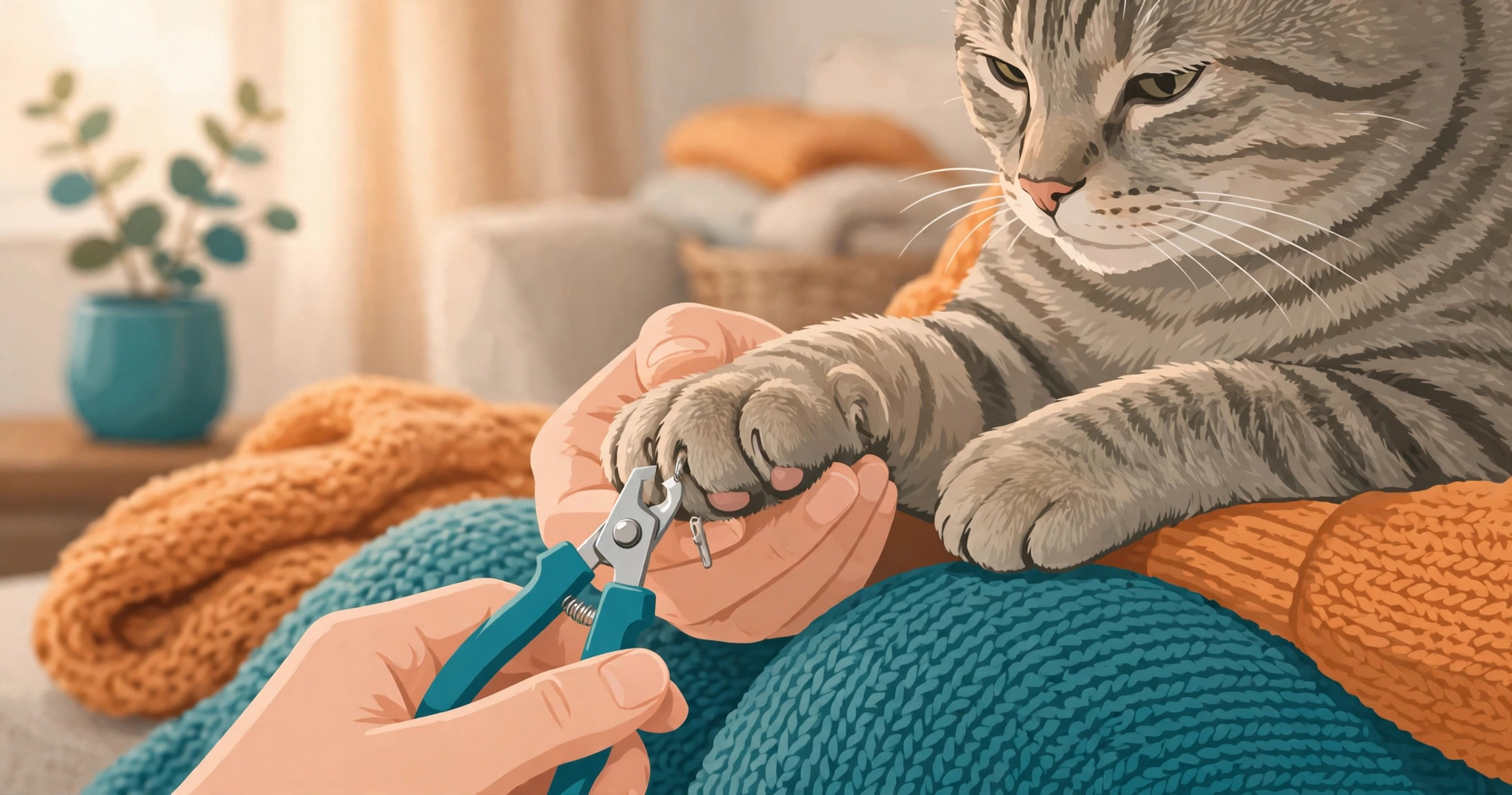
Most nail-trim disasters share the same script: wait until the claws are snagging on everything, pin the cat down on a Saturday morning, wrestle all eighteen claws, and then avoid the clippers for three months. There is a calmer way, and it starts from accepting a smaller goal. A trimmed front paw, two claws, even a single nail — clipped without fear — is a success. A panicked full trim is not.
Why indoor cats still need trims
Scratching posts help, but they do not file claws the way rough outdoor terrain does. Indoor nails keep growing in a curve and can snag on bedding, curl toward the pad, or scratch you by accident. Cornell's Feline Health Center notes that regularly trimming your cat's nails reduces the likelihood of damage from sharp claws and lessens the chance of a nail growing into the foot pad and causing infection — and that starting the routine early makes the task easier as your cat gets older. Source: Cornell Feline Health Center, choosing and caring for your new cat.
How often? Every two to four weeks is the usual cadence. Front claws usually grow faster and catch on things first, so most people trim the fronts and give the backs and the dewclaws (the small "thumbs" on the inner legs) a check at the same time. The Humane World for Animals claw-trimming fact sheet suggests exactly this rhythm, with front paws first and a check of the back paws and dewclaws each round. Source: Humane World for Animals, how to clip your cat's claws safely (PDF).
Choose the moment, not the battle
Never start when the cat is in zoomie mode. The best trim windows are the quiet ones: mid-nap, post-meal drowsiness, or the slow evening settle on the sofa. Sit somewhere the cat already associates with calm — your lap, their usual spot — and spend a minute on the usual petting first.
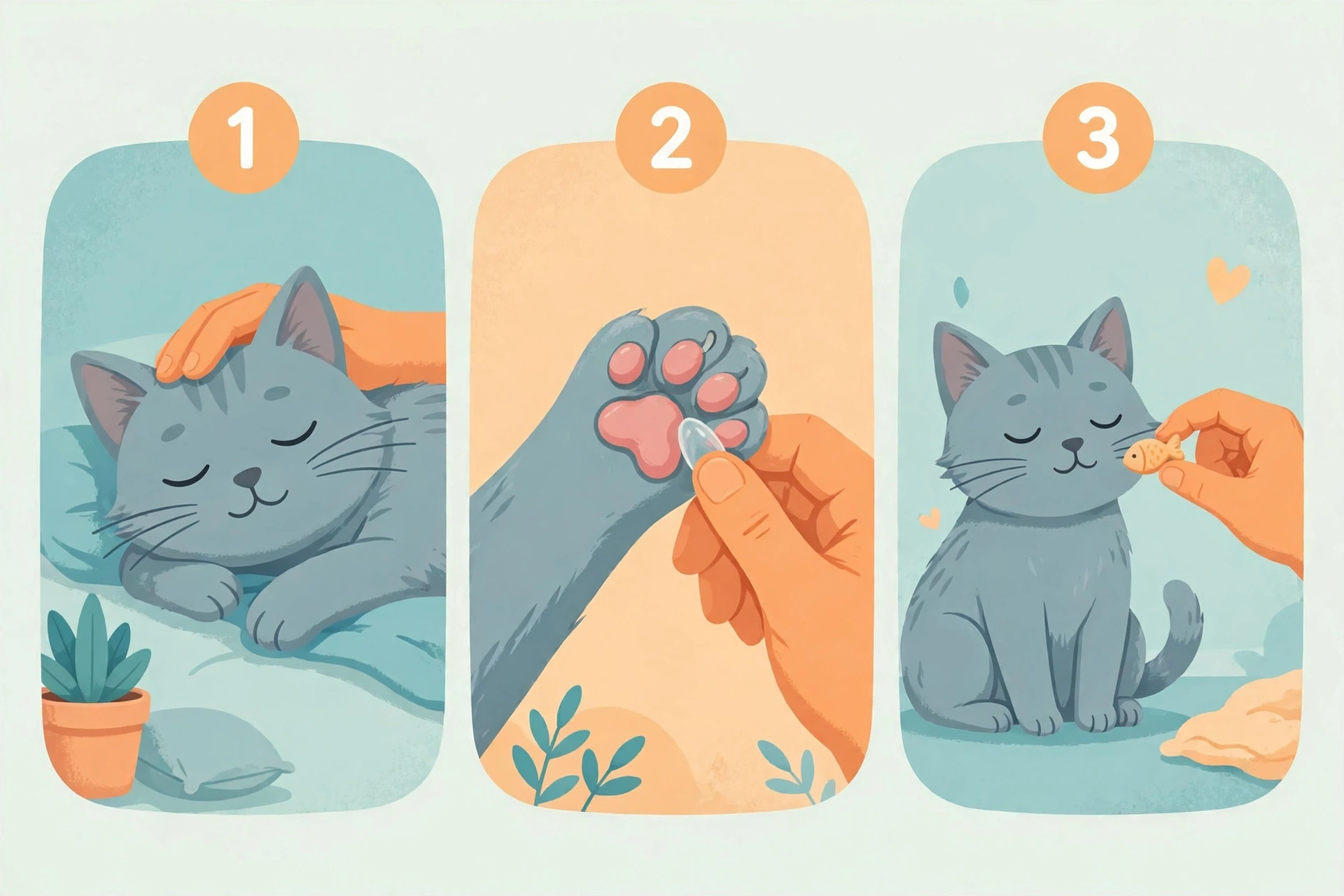
The desensitisation habit is what makes this a routine instead of an event. On non-trim days, occasionally touch the paws and press a pad gently to extend a claw, then immediately reward with a treat or a chin scratch. The cat learns that paw handling predicts good things, not an ambush. Do this a few times over a week before the clippers come out, and the first real trim starts from a very different place.
What you actually need
The kit is small: a pair of nail clippers made for cats (the small scissor type gives the best control), a treat your cat genuinely likes, and styptic powder — or cornstarch from the kitchen as a backup — in case a nail bleeds. Ask your veterinarian to demonstrate the technique once, which Cornell recommends as the starting point for beginners. Source: Cornell Feline Health Center.
One thing that does not belong in the kit: restraint. If it takes a towel wrap, two people and a door between the cat and escape, the session is already too ambitious. Shorten the plan instead — fewer claws, not more force.
Find the quick — the pink line you never cross
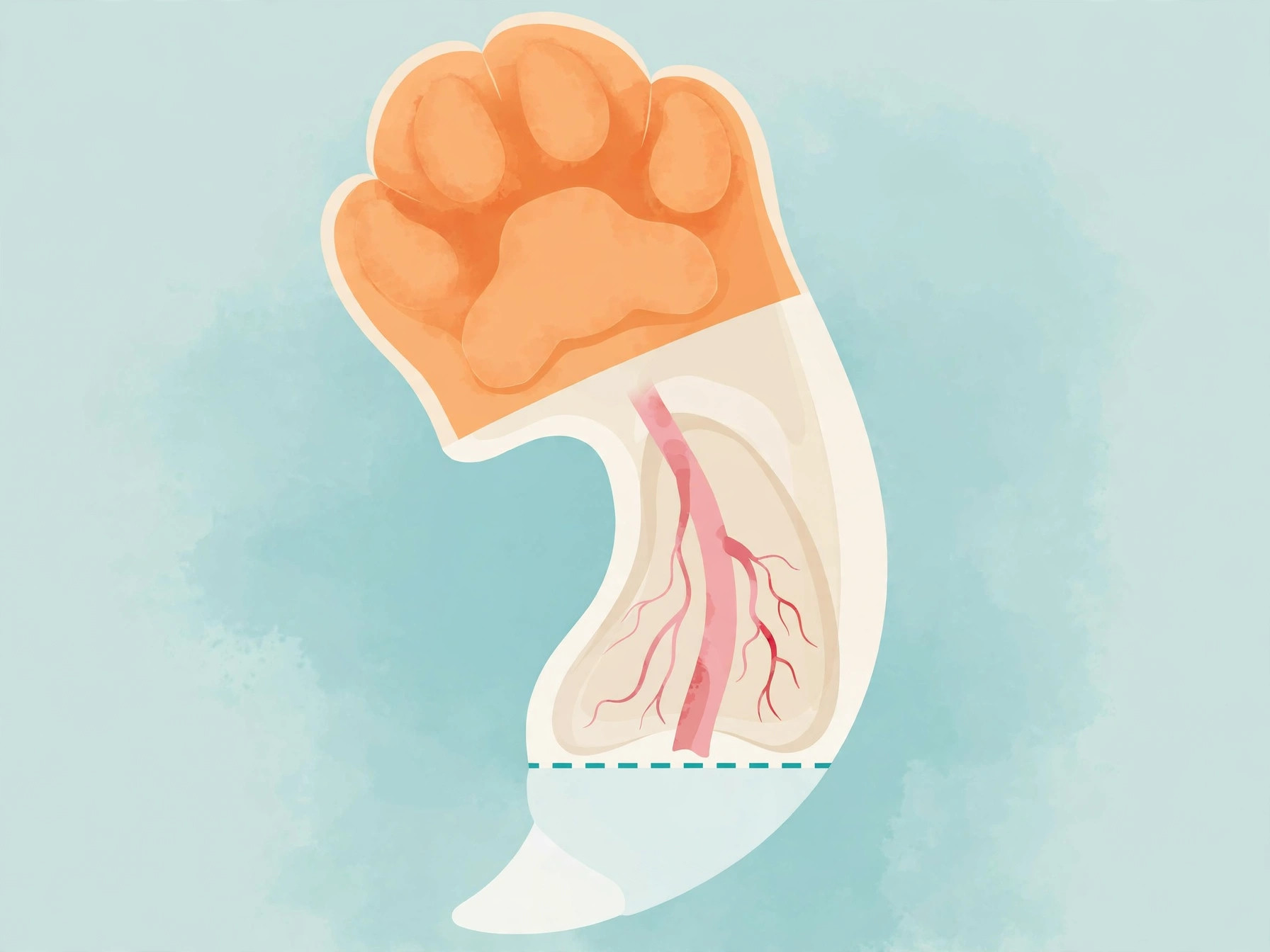
Extend a claw by pressing the pad gently from above and below. Inside the pale nail you will see a pinkish triangle: the quick, a bundle of nerve and blood vessel. Cutting it hurts and bleeds. Your job is only ever the pale, curved hook past it — a few millimetres from the tip. On dark nails the quick is hidden; shine a light behind the nail if it helps, and cut conservatively. You can always take more next time.
The angle matters a little too: clip straight across the tip, staying well clear of the pink. If the quick is close on every nail and the claws are long, trim a little every week rather than a lot once — the quick slowly recedes when the nail is kept short.
The first session: one claw is a win
Here is the whole protocol for week one: wait for a sleepy moment, pet the cat, handle one front paw, extend one claw, clip just the sharp hook, reward immediately, and put the clippers away. That is a complete session. If the cat stays relaxed, do another claw. If the tail starts thumping or the ears tilt back, stop — that was enough.
Expect the first full trim to take two or three sessions spread over a few days. This is normal, not a failure; it is exactly what the Humane World for Animals guidance suggests — that it is better to trim one or two nails calmly than to force a full trim. Source: Humane World for Animals, how to clip your cat's claws safely (PDF).
If a nail bleeds, and when to ask your vet
If you nick the quick, stay calm: press styptic powder or a pinch of cornstarch onto the nail tip with gentle pressure and the bleeding usually stops within a few minutes. The cat will forgive faster than you will. But do not trim that nail again until it has fully healed, and if bleeding will not stop or the toe looks swollen, call your veterinarian.
Call your vet too if a claw has already grown into the pad, if the cat limps or guards a paw, or if you simply cannot do this safely at home. A groomer or a vet tech can trim nails in minutes, and watching them once is the fastest way to learn. Note that declawing is not a nail-trimming shortcut: Cornell describes it as an amputation of the bones at the tips of the paws, carrying surgical risk, and recommends it only as an absolute last resort. Source: Cornell Feline Health Center, feline behavior problems: destructive behavior.